Beyond Human Capital: The CHRO’s New Mandate in the Age of AI Agents by Sharmilaa Thakur

When AI agents become part of how work gets done, HR can no longer govern only people. The CHRO must help redesign work, workforce, leadership and accountability.
For decades, Human Resources has been called the steward of human capital.
We built talent strategies.
We designed organisations.
We hired people, developed leaders, managed performance, shaped culture and planned workforces.
But what happens when the workforce itself begins to include something that isn't human?
AI agents.
That question is no longer theoretical.
AI agents are moving beyond simple assistants toward systems capable of executing tasks, interacting with other systems, and operating with increasing degrees of autonomy.
PwC now describes them as “workforce counterparts”, while Gartner is explicitly examining how agentic AI is changing managerial accountability and CHRO responsibilities.
And that creates a much bigger question for business leaders:
If AI agents become part of how work gets done, who governs the workforce?
My view is that this is one of the most consequential questions facing the CHRO in this decade.
Not because HR should own AI technology.
But because HR owns the discipline of understanding people, work, organisation, capability and the employee relationship.
And AI is now changing all five.
From AI adoption to workforce redesign
The first corporate conversation around AI was largely technological.
Which model should we use?
Which platform should we buy?
How do we deploy generative AI?
How do we improve productivity?
The conversation is changing.
The real question is increasingly:
How should work itself be redesigned?
McKinsey's 2026 research describes this as HR's dual mandate: transform HR itself while simultaneously helping the wider organisation redesign roles, reskill people and build the architecture for human–agent collaboration.
That distinction matters.
Automating an existing process is not the same as redesigning work.
Replacing a repetitive task with AI may produce efficiency.
But redesigning the workflow around what humans do best and what AI does best can produce something much more valuable: a fundamentally different operating model.
This is where the CHRO's role becomes much more strategic.
I have seen this transformation before—but at a different speed
Throughout my career in HR transformation, I have seen organisations move through several technology waves.
HRIS replaced paper-based processes.
Enterprise systems transformed HR operations.
Analytics changed how leaders understood workforce data.
Digital recruitment changed talent acquisition.
AI began changing how organisations source, screen and engage talent.
Each time, there was a temptation to see the technology as the transformation.
But the organisations that created sustainable value were the ones that changed the process, operating model, capability and behaviour around the technology.
That lesson is becoming even more important with AI.
Because agentic AI doesn't simply automate a transaction.
It can potentially change who performs the work, how decisions are made, how managers operate and what skills the organisation needs.
That is not an IT implementation.
That is Organisational Transformation.
The workforce is becoming hybrid
Traditional workforce planning asks:
How many people do we need?
Which skills do we need?
Where should they be located?
How much will they cost?
When should we hire them?
The emerging workforce-planning question is different:
What combination of human capability and AI capability do we need to deliver our strategy?
Imagine a customer-service organisation with 500 employees supported by thousands of AI-driven workflows.
Imagine HR where agents continuously support recruitment, employee queries, onboarding, workforce analytics and learning.
Imagine finance, technology, procurement or legal teams where humans increasingly supervise networks of specialised digital agents.
The organisation is no longer simply planning headcount.
It is planning capacity.
And that requires a new workforce architecture.
KPMG's recent analysis makes the issue particularly provocative, arguing that as AI agents enter organisations, the question of who manages them becomes increasingly important—and that CHROs have a structural claim to part of this mandate because the transformation fundamentally concerns jobs, skills, organisation and governance.
The CHRO's job is changing
The traditional HR value chain looked something like:
Hire → Develop → Reward → Retain
The emerging one increasingly looks like:
Design → Augment → Reskill → Redeploy → Govern
The question is no longer simply:
“What jobs do we need?”
It becomes:
“What work should be performed by humans, what work should be performed by AI, and where should humans and AI collaborate?”
That is a profound organisational-design question.
And it brings the CHRO into territory traditionally associated with the CIO, CTO, COO and increasingly the Board.
Gartner's research explicitly identifies the need for shared ownership between CIOs and CHROs as organisations redefine work around agentic AI.
The answer isn't for HR to take over technology.
Nor should technology leaders attempt to design the workforce in isolation.
The future requires partnership.
Technology builds the rails.
HR helps redesign the workforce travelling on them.
But there is a governance problem

Here is where the conversation becomes much more serious.
Suppose an AI system recommends:
which candidate should be shortlisted;
who should receive development opportunities;
which employee may be at risk of leaving;
which role should be redesigned;
which workforce costs should be reduced;
which employee should receive additional monitoring;
or which performance pattern should trigger managerial intervention.
Who is accountable?
The AI?
The vendor?
The manager?
The CHRO?
The CEO?
The Board?
The answer cannot be:
“The algorithm decided.”
Accountability cannot be delegated to a machine.
PwC's current governance framework for AI agents emphasises verified identity, defined roles, task-specific permissions, auditability and increasing human oversight as agent autonomy and consequences increase.
Gartner is making a related point from the management side: managers are increasingly responsible not only for people and tasks, but also for the behaviour, outputs and risks of autonomous digital agents operating alongside their teams.
That means AI governance and workforce governance are beginning to converge.
This is where the Board enters the conversation
AI governance can no longer be treated purely as a technology issue.
Consider the chain:
AI strategy
↓
Workforce redesign
↓
Employment decisions
↓
Data and privacy
↓
Skills and capability
↓
Employee trust
↓
Regulatory exposure
↓
Reputation and enterprise risk
That is a Board conversation.
Recent Harvard Business Review analysis similarly points to AI reshaping not just operational roles but the responsibilities of senior executives and Boards themselves.
The Board should therefore be asking management:
1. Where is AI making or influencing decisions about our workforce?
2. Which decisions must remain human?
3. Who is accountable for AI-supported employment decisions?
4. What controls exist over AI agents accessing enterprise systems?
5. How are bias, discrimination and explainability being addressed?
6. What happens when an AI decision is wrong?
7. How are employees informed about AI's role in their work?
8. What new capabilities will our organisation need?
9. How are jobs and career pathways being redesigned?
10. What metrics does the Board receive on AI-related workforce risk and value?
These are no longer futuristic questions.
They are emerging governance questions.
The biggest mistake would be to measure AI only through productivity
There is an understandable temptation to measure AI success through:
cost reduction + headcount reduction + productivity.
Those metrics matter.
But they are insufficient.
An organisation can automate thousands of tasks and still create a weaker workforce.
Why?
Because productivity is not the same as organisational capability.
If junior employees rely entirely on AI to complete work, where does professional judgement develop?
If managers supervise increasingly autonomous systems, what new management capabilities do they need?
If traditional career ladders disappear, how do employees build experience?
If AI eliminates entry-level tasks, what happens to the talent pipeline?
If employees are measured by AI usage rather than business outcomes, do we accidentally create the wrong behaviours?
These are HR questions.
And they are becoming strategic questions.
From Jobs to Work

One of the most important shifts for CHROs is moving the organisation away from thinking primarily in terms of jobs.
A job is a container.
Work is what actually happens inside it.
Historically, organisations designed roles around responsibilities, reporting lines and job descriptions.
The AI era gives us an opportunity to ask a more fundamental question:
What is the work we actually need to accomplish?
Then:
What should humans do?
What should AI do?
What should humans and AI do together?
What capabilities are required to make that model work?
That is a fundamentally different approach to organisational design.
PwC's workforce research similarly argues that agentic AI is reshaping roles and teams, reinforcing the need to redesign work rather than simply automate existing tasks.
The New CHRO Scorecard
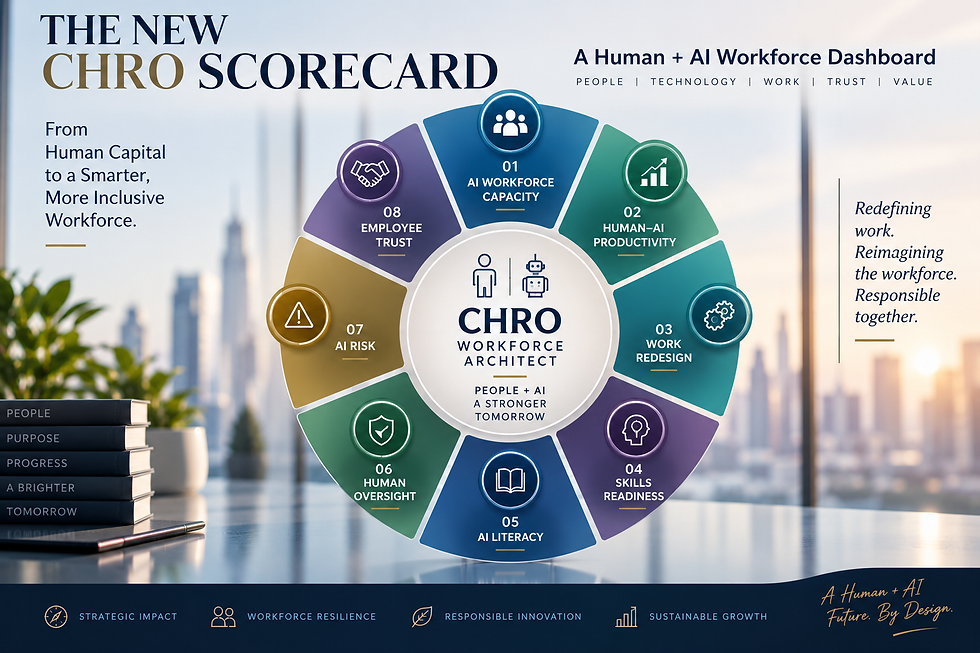
If this is the future, the traditional HR scorecard also needs to evolve.
Beyond:
Attrition | Engagement | Hiring | Cost | Diversity | Learning
we need measures such as:
AI Workforce Capacity
How much work is performed or supported by AI agents?
Human–AI Productivity
Are people actually becoming more productive—or simply generating more activity?
Work Redesign
How many roles have been fundamentally redesigned?
Skills Readiness
Do we have the capabilities required for the future operating model?
AI Literacy
Can leaders and employees understand how to use AI responsibly?
Human Oversight
Which high-impact decisions require human review?
AI Risk
Where could AI create employment, regulatory, ethical or reputational exposure?
Employee Trust
Do employees understand how AI affects their work and careers?
This is where traditional HR analytics needs to evolve toward workforce intelligence.
What should CHROs do now?
I would start with five actions.
1. Build an AI Workforce Map
Map critical work across the organisation and classify it:
Human-only | AI-assisted | AI-automated | Human + AI
This creates the foundation for workforce redesign.
2. Establish AI Decision Rights
Define what an AI system can:
Recommend → Initiate → Execute → Escalate
—and where mandatory human approval is required.
3. Redesign Jobs, Not Just Tasks
Don't begin with:
“How many jobs can AI eliminate?”
Begin with:
“How can we redesign work so humans spend more time creating value?”
4. Integrate AI Governance with HR Governance
Any AI system affecting people should have appropriate consideration of:
data → privacy → fairness → employee impact → accountability → auditability → regulatory compliance.
5. Take the Conversation to the Board
The CHRO should proactively explain:
Where AI is changing work.
Where it is changing the workforce.
Where it is changing management.
Where the risks are.
And where the organisation is creating value.
The CHRO may become the Chief Workforce Architect
Perhaps the most interesting question isn't whether the CHRO will become less important because of AI.
It may be the opposite.
If HR remains primarily an administrative function, AI will automate significant parts of it.
But if HR becomes the function responsible for helping the enterprise understand and redesign the relationship between:
People + Work + Technology + Capability + Culture + Governance
then the strategic importance of the CHRO could increase substantially.
This is why I find the emerging concept of the Chief Workforce Architect compelling.
The title itself may or may not survive.
The responsibility will.
The future is not Human vs AI
We should resist or atleast counter to reconsider two simplistic narratives.
“AI will replace humans.”
And:
“AI will never replace humans.”
Neither is sufficiently useful for leaders.
The more important question is:
How do we design an organisation where human judgement and machine intelligence complement each other—and where accountability remains clear?
That requires more than technology.
It requires:
workforce strategy.
organisation design.
leadership.
skills.
culture.
governance.
And above all:
intentional design.
The question every CHRO and Board should be asking
The most important question may no longer be:
“How will AI change our jobs?”
It may be:
“Who will design, govern and lead the workforce when the workforce is no longer entirely human?”
That is the conversation I believe CHROs need to lead.
Because the future of work is not simply about whether machines can do more.
It is about how organisations choose to work differently because machines can do more.
And that makes AI one of the biggest organisational-design, workforce-strategy and governance challenges—and opportunities—of our generation.
My perspective
After more than two decades working across HR leadership, transformation, technology-enabled HR, workforce strategy and organisational change, one lesson has remained consistent:
Technology rarely creates transformation by itself. People, processes, leadership and organisational design determine whether technology creates sustainable value.
AI will be no different.
The organisations that win will not necessarily be those that deploy the most AI.
They will be those that learn to combine:
human judgement + machine intelligence + organisational capability + responsible governance.
And the CHRO has a critical role to play in making that happen.
The future of HR isn't simply AI-enabled HR.
It is human-centred, AI-enabled organisations.
And perhaps the CHRO's greatest mandate of all is not to manage the workforce of yesterday—
but to help design the workforce of tomorrow.
The future of work is no longer approaching.
It is being designed now.
About the Author
Sharmilaa Thakur is a senior global HR and People Transformation leader with 25+ years of experience across technology, SaaS, telecom, financial services, healthcare, FMCG/manufacturing and global shared-services environments, with experience spanning India, APAC, the Middle East, Europe and North America.
She has held senior HR leadership and transformation roles focused on enterprise HR strategy, organisational design, workforce transformation, talent and leadership development, HR technology, AI-enabled HR, culture and change management. Her work sits at the intersection of people, technology, business strategy and the future of work.
She is particularly interested in how organisations can responsibly combine human capability, AI and emerging technologies while preserving leadership accountability, employee trust and organisational effectiveness.
Website: sharmilaathakuronline.com


Comments