Reimagining Talent Acquisition in the Age of AI: From Human Judgment to Augmented Intelligence
- Sharmilaa Thakur
- Nov 12, 2025
- 4 min read
By Sharmila Thakur— Global HR Transformation & Future of Work Leader
Introduction: The Inflection Point for Talent Strategy
Organizations today stand at a profound inflection point.
Artificial Intelligence (AI) is no longer a tool to automate tasks — it’s an intelligent
collaborator reshaping how organizations attract, assess, and engage talent — not as a passing technological phase, but as a structural shift redefining the future of human capital itself.
For HR leaders, this evolution demands more than adoption. It calls for reimagination — of how we define potential, build capability, and sustain inclusion in a borderless world of work.
The new mandate is clear:
Blend human judgment with augmented intelligence to accelerate performance without compromising dignity.
Artificial intelligence is transforming how enterprises attract, assess, and engage talent.
For global HR leaders, this moment demands more than automation or analytics. It calls for a rethinking of how organizations identify potential, shape capability, and sustain inclusivity at scale. The imperative is clear: to combine human judgment with augmented intelligence in a way that accelerates both business growth and workforce dignity.
Step 1: Defining the Strategic Niche — The Convergence of AI and Global Workforce Architecture
In a hyperconnected, hybrid, and globally distributed ecosystem, Talent Acquisition (TA) must evolve from a transactional process into a strategic capability — one that architects the future workforce.The next-generation talent function sits at the intersection of four converging forces:
1. AI + DEI IntegrationIntelligent systems are only as ethical as the data behind them. HR leaders must ensure AI reinforces fairness, not bias — embedding inclusive design principles in every algorithm and decision layer.
2. Predictive Workforce IntelligenceWe are moving from “filling roles” to “forecasting capabilities.” Predictive analytics allow HR to anticipate skills demand, model workforce agility, and align pipelines with future enterprise growth.
3. AI + Global Workforce ArchitectureThe borderless workforce is here to stay. AI-enabled platforms can now map global skills, optimize workforce composition (permanent, contingent, gig), and fuel mobility across continents and time zones.
Workforce Simulators model future scenarios for headcount agility and cost efficiency.
Digital Mobility Engines align internal capabilities with global opportunity.
Cross-Border DEI Metrics ensure inclusion scales as organizations globalize.
4. Strategic HR as a Value CreatorWhen talent intelligence is integrated into the enterprise’s decision architecture, HR shifts from being a cost centre to a value-creation engine — influencing growth, investor confidence, and innovation velocity.
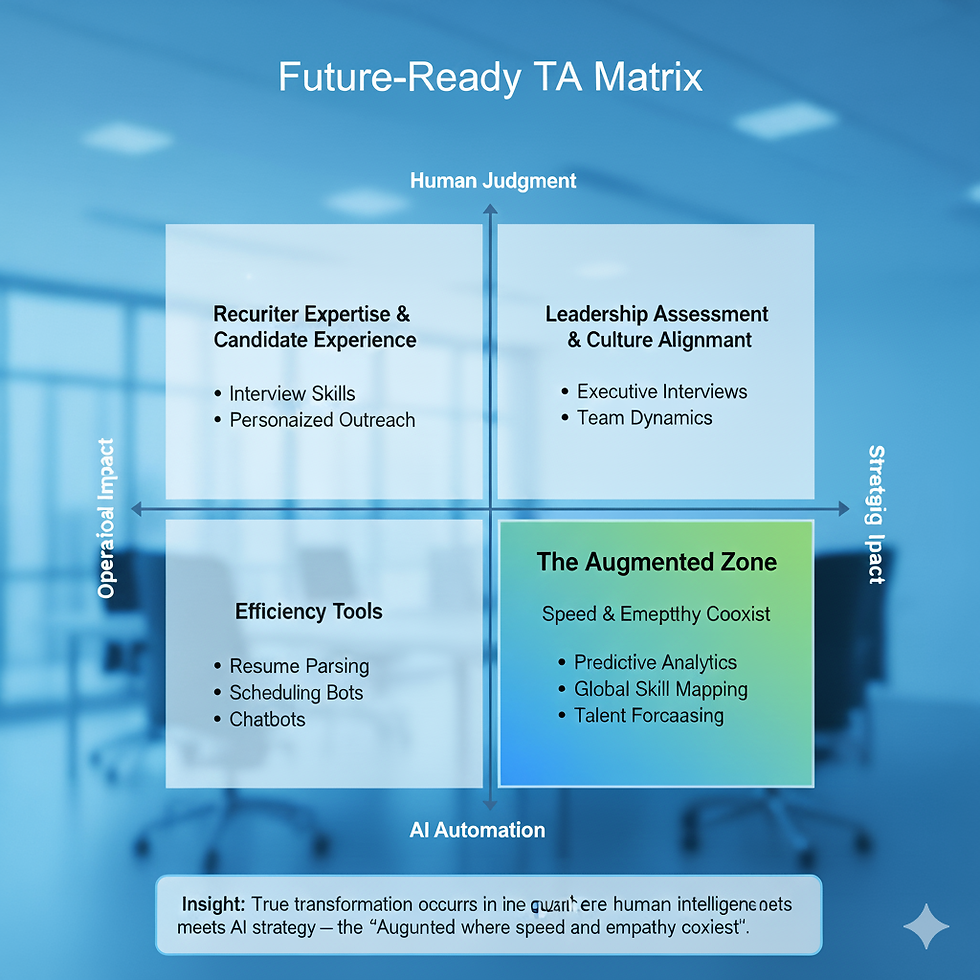
True transformation occurs in the quadrant where human intelligence meets AI strategy — the “Augmented Zone” where speed and empathy coexist.
The future belongs to those who master this balance — where recruiters become data translators, and technology becomes an empathy amplifier.
Step 2: Aligning with Stakeholder Priorities
Talent decisions today shape not only hiring outcomes but also investor narratives and brand reputation.Different stakeholders see AI’s role through distinct lenses:

Also our current and potential future resources seek more clarity
· Employees: expect fairness, transparency, and growth opportunities.
· Candidates: demand personalized, frictionless, and purpose-driven experiences
Step 3: Translating Technology into Leadership Language
The most effective HR Leaders simplify complexity. They don’t sell “systems” — they sell strategic enablement.The C-suite responds to outcomes, not acronyms.
When communicating AI transformation to leadership, frame it as:
“A balanced orchestration where technology amplifies — not replaces — human discernment.”

Step 4: Establishing Relevance — The 2025-26 Talent Acquisition Priorities
· AI Ethics & Governance: Shifting from compliance to conscience — ensuring technology strengthens fairness and accountability.
· Candidate Experience Reimagined: Designing seamless, human-centered digital journeys.
· Global DEI Integration: Building inclusion without borders.
· Talent Intelligence Ecosystems: Connecting ATS, LMS, HRIS, and BI pipelines into one real-time human capital architecture.
· Data-to-Strategy Conversion: Transforming insights into leadership decisions that drive enterprise value.
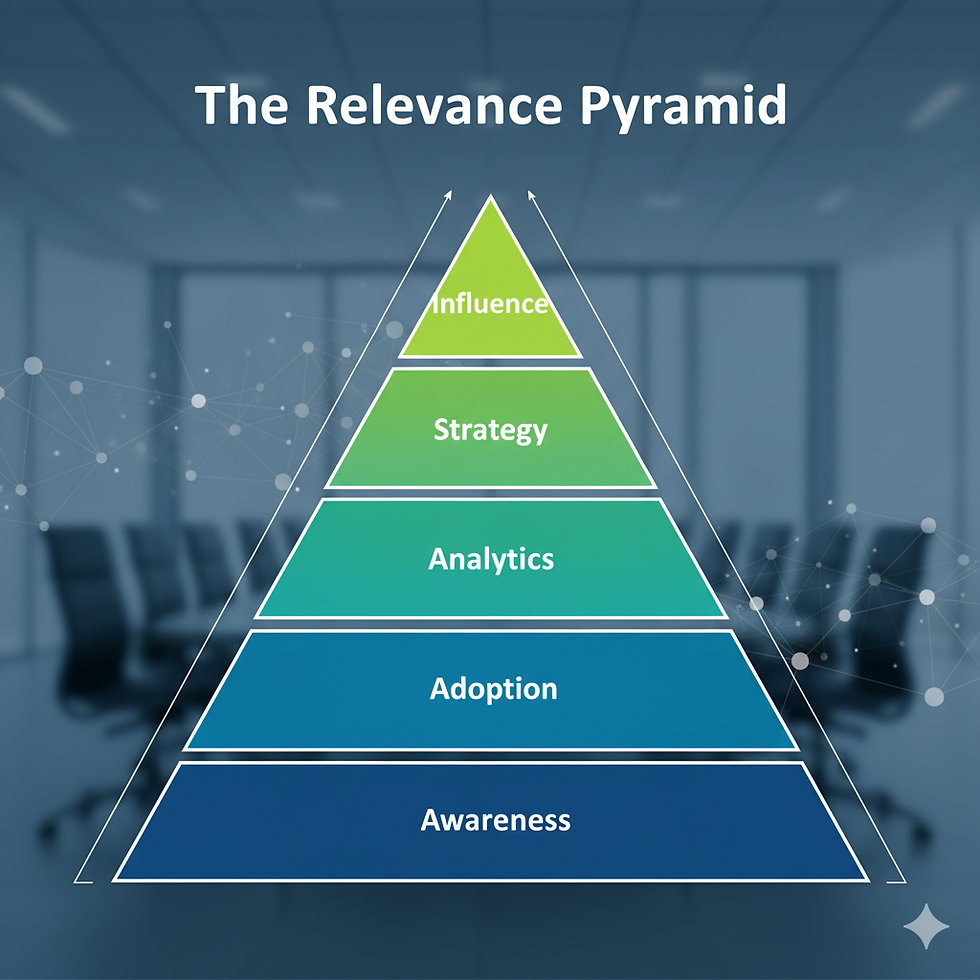
Every insight should rise from awareness to strategy, linking people metrics to business outcomes.
Step 5: Embedding Governance and Accountability
AI transformation is not purely operational — it’s a matter of governance.Boards increasingly assess human capital resilience as a critical component of enterprise risk.
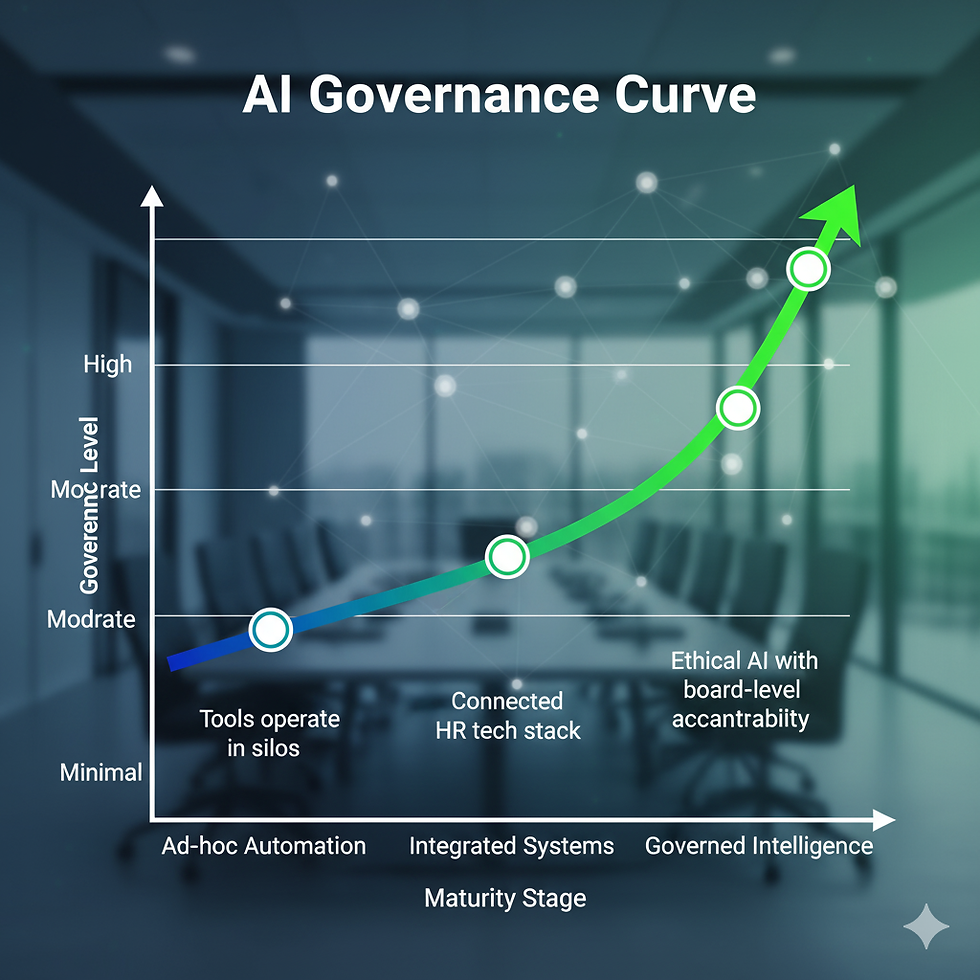
The AI Governance Curve shows how organizations evolve from fragmented adoption to full strategic oversight:
· Foundational Stage/Ad-hoc Automation: Pilots and tool experimentation.
· Integrated Systems Stage: Standardized AI systems with ethical guardrails.
· Institutional Stage/Governed Intelligence: AI becomes part of board-level risk and performance dialogue.
Step 6: Building a Culture of Continuous Leadership Influence
AI-led transformation demands visible leadership sponsorship.
Transformation doesn’t succeed through systems; it thrives through visible sponsorship.When HR Leadership publicly share insight — through panels, internal storytelling, or thought leadership — they accelerate organizational readiness and elevate HR’s strategic voice.
When CHROs and HR VPs share insight publicly — through blogs, panels, and internal storytelling — they accelerate enterprise readiness.

Step 7: Balancing Data with Humanity
The most sophisticated AI model still needs the warmth of human intention.
Even the most sophisticated AI model cannot replicate empathy.
Data may drive accuracy, but empathy sustains connection.
Data drives precision, but empathy drives connection — and connection is what builds belonging.

The leaders who master this equation will define the next era of HR — one where intelligence is not artificial, but augmented with purpose.
Closing Perspective: HR as the Architect of Enterprise Intelligence
AI in Talent Acquisition is not merely a digital evolution; — it’s the blueprint for a new era of enterprise design, it is the foundation of a new operating philosophy.
Tomorrow’s successful organizations will be those that combine analytical precision with human understanding — where every hiring decision reflects both data and dignity.
For CHROs and HR leaders, the challenge — and the privilege — is clear:to ensure technology serves humanity, not the other way around.
“Where Technology Meets Humanity — Redefining Talent in the Age of Intelligent Enterprises.”
So If data drives precision and empathy drives connection — which one do you think will define the next era of HR leadership?
As we architect global workforces powered by AI, are we enhancing human capability — or engineering it out of the system?
Thank you for reading till the end.
Share your thoughts !!#FutureOfWork #AIinHR #TalentAcquisition #HumanResources #HRTransformation #CHROInsights #GlobalWorkforce #LeadershipDevelopment #DEI #PeopleStrategy #WorkTech #AugmentedIntelligence #FutureReadyOrganizations #DigitalHR #HRLeadership #WhereTechnologyMeetsHumanity



Comments